
DYNOS
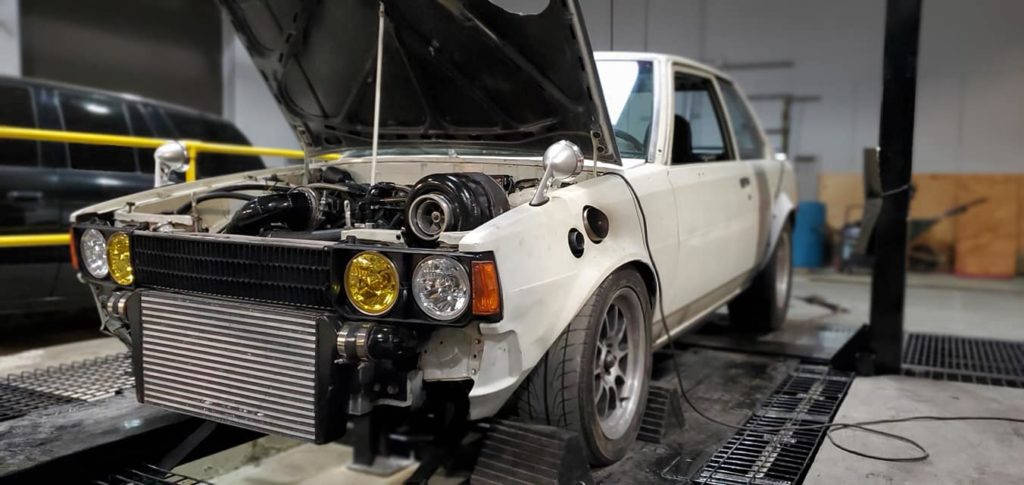
With that in mind, HAC uses only eddy current load cell dynamometers. Why? Because they provide a more accurate simulated load for data collection than non load cell, also known as an inertia dyno.
Take this analogy as the basic difference a load cell dyno and an inertia dyno. Let us pretend you are lucky enough to by yourself a brand spanking new C7 Corvette Z06. This car weighs approximately 3500lbs with you, your significant other, and a tank of gas. When you are driving to the grocery store and you up-shift to 4th gear and hit the long pedal on the right, a lot of things happen as far as what the computer is going to do, but nothing changes the fact that the engine is working against all 3500lbs of mass, plus pushing a significant amount of air around the Corvette.
A few weeks later you visit a “Dyno Day” and decide to see what your car does. The dyno is an inertia dyno, which means it calculates horsepower by the acceleration of the mass of the rollers over time (definition of horsepower). You know your Corvette weighs 3500lbs, because I just told you, but you start to wonder how much those big drums your tires are spinning weigh. You decide to ask the operator, who is a nice enough chap, and explains to you that the “rollers” weigh 2500lbs, as he hands you your dyno numbers.
Now you are a smart guy, after all you did just buy yourself a new Z06, and you instantly realize that while on that dyno, the engine is only working to accelerate 2500lbs and not the 3500lbs your car weighs. You think to yourself: So what happens with that missing 1000lbs? Is it like racing downhill?
This question ferments in the deepest regions of you psyche, and one evening you decide to do some research. Serendipity strikes and you come across HAC’s website and start reading this very explanation, which begins to explain that a load cell dyno, such as a Mustang, uses a “Eddy Current Generator” as a way to apply additional braking resistance against the dyno’s rollers in order to simulate real world conditions. In other words, on a Mustang dyno, when you up-shift into 4th gear, and hit the gas pedal, the dyno is applying additional resistance against rollers to replicate not only the missing 1000lbs in mass, but also the force needed to overcome the amount of air moving past the vehicle at a given speed.
The next morning you book yourself an appointment to make a dyno pull at another location that has a Mustang MD-1100SE chassis dynamometer. This time, your car records approximately 25 less horsepower at the rear wheels. The operator starts to explain, but you stop him, stating that you understand the difference. But then you ask a very important question, “So why use an inertia dyno?”
To which he replies, “Exactly.”